Feed inlet & metering
Control what reaches the chamber. Receive prepared fruit at a controlled rate without relying on operators to force material into an opening.
Home / Industrial fruit crushing
Explore the PS industrial fruit crusher: feed hopper, working assembly, motor, mash discharge and model references from 1 to 25 t/h on a stated feed basis.
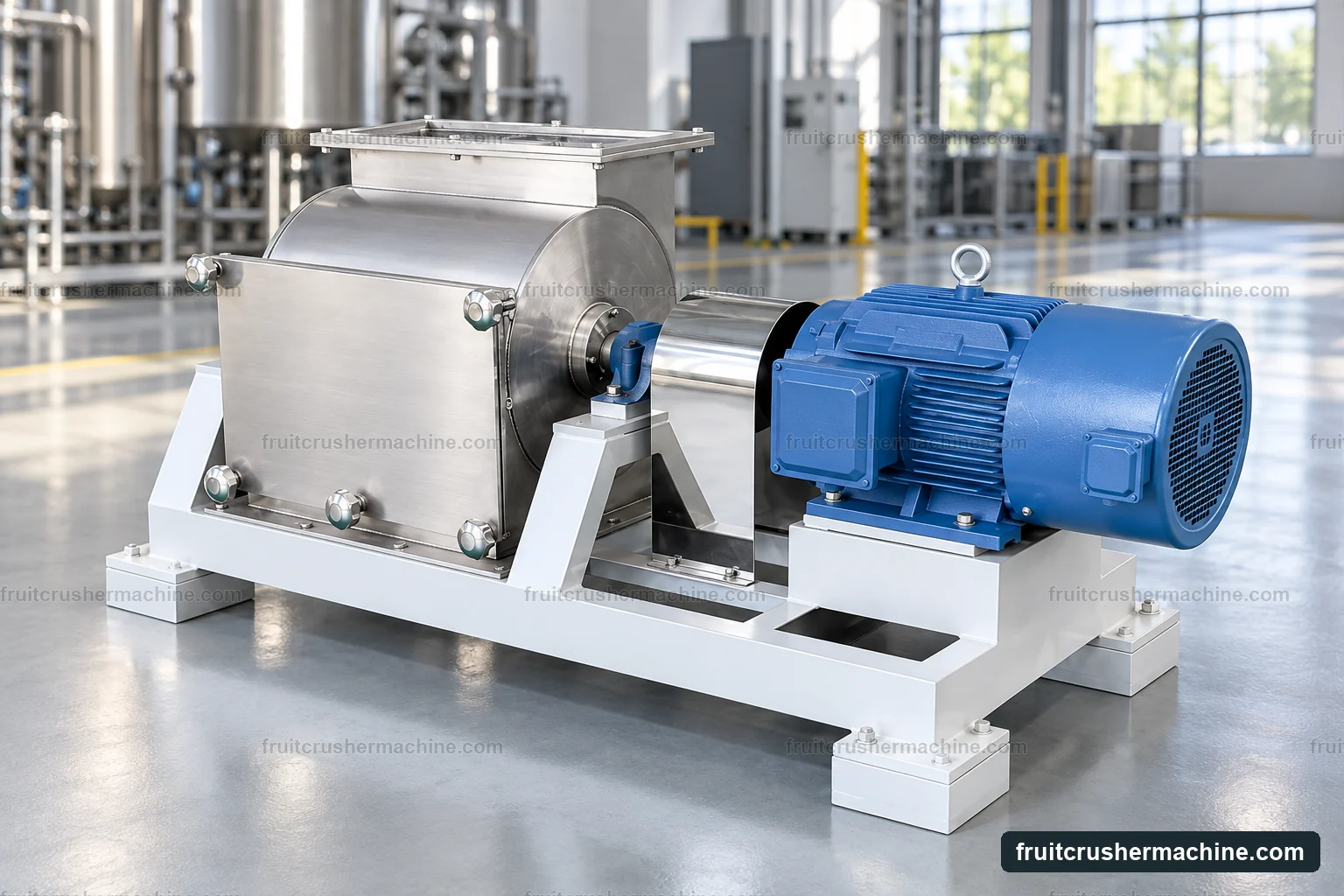 PS series equipment family view. Exact model, construction and dimensions are confirmed in the quotation.
INSPECT THE CRUSHER
The closed-machine view shows the hopper, chamber housing, frame and motor. The open view exposes the working assembly and perforated lower section. Confirm the offered model against its own drawing.
Explore the machine specification →PS SERIES · MODEL COMPARISON
Compare five published model references, then confirm the duty on your prepared fruit. The photographed machine is a family view; confirm the exact offered model, construction and dimensions in the quotation.
| PS model | Catalogue feed rate | Motor power | Published speed |
|---|---|---|---|
| PS-1 | 1 t/h | 2.2 kW | 1470 r/min |
| PS-5 | 5 t/h | 5.5 kW | 1470 r/min |
| PS-10 | 10 t/h | 11 kW | 1470 r/min |
| PS-15 | 15 t/h | 15 kW | 1470 r/min |
| PS-25 | 25 t/h | 22 kW | 1470 r/min |
Catalogue prepared-feed references, not guaranteed capacity for every fruit. Confirm performance, dimensions and working parts for the exact offered model.
Explore each PS model →| Area | Machine and integration detail |
|---|---|
| Feed hopper | A rectangular hopper feeds the horizontal chamber. Agree fruit condition, maximum prepared-piece size and the upstream conveyor height; the opening alone is not a safe feed specification. |
| Cutting chamber | A shaft-driven working assembly reduces permitted fruit inside the enclosed chamber. The open view shows a slotted assembly and perforated lower section; confirm the exact cutting elements and screen for the selected model. |
| Drive and frame | The photographed family machine mounts a blue electric motor and chamber on a welded skid frame. PS-series motor ratings are shown above; guarding, electrical supply and controls belong in the final configuration. |
| Discharge | Crushed material leaves the chamber for a defined gravity, pump or conveyor handover. The press or pulper downstream is a separate equipment choice with its own permitted feed condition. |
| Cleaning access | The opening chamber gives access to the working assembly and lower perforated section. Document isolation, removal, drainage and reassembly for the offered configuration; an exterior wash does not clean the product path. |
| Acceptance | Identify the chosen model and working parts, then trial representative fruit for observed feed rate, mash condition, retained material and downstream behaviour. |
Tell us the fruit, any hard stones, prepared feed size, target feed rate and whether the mash goes to pressing or pulping. We can then match the PS family reference to the required working assembly, installed dimensions and a representative trial. The displayed photographs show the equipment family; confirm the exact offered model in the quotation.
Enquire about a complete crusherControl what reaches the chamber. Receive prepared fruit at a controlled rate without relying on operators to force material into an opening.
Inspect the product path, not just the cover. Contain the size-reduction task and direct product toward a controlled discharge. The chamber geometry must match the actual supplied structure.
Match the structure to the fruit and the next process. Create the required material breakdown using the actual proposed working assembly. Tooling, clearance and any screen are evaluated together.
Specify the operating load and the installation. Drive the working assembly with suitable controls and protection for the actual fruit, starting conditions and operating duty.
Let the next machine set the handover. Move crushed fruit out of the chamber without uncontrolled accumulation, leakage or an incompatible connection to the receiver.
Review the complete operating boundary. Coordinate access protection, emergency stopping, feed and discharge response using the machine-specific design and installation risk assessment.
Measure the space needed after installation. Provide access to inspect, clean and replace machine parts without losing control of product residues or reassembly quality.
Connect to a press or a pulper with defined inputs. Specify the crusher outlet as the inlet to a separate processing stage, including the transfer equipment and its control responsibilities.
Use the actual prepared feed and an observed trial to set the specification.
Define maximum feed size → Interpret observed throughput →