Home / Industrial fruit crushing
Working parts & output control for fruit crushing
Create the required material breakdown using the actual proposed working assembly. Tooling, clearance and any screen are evaluated together.
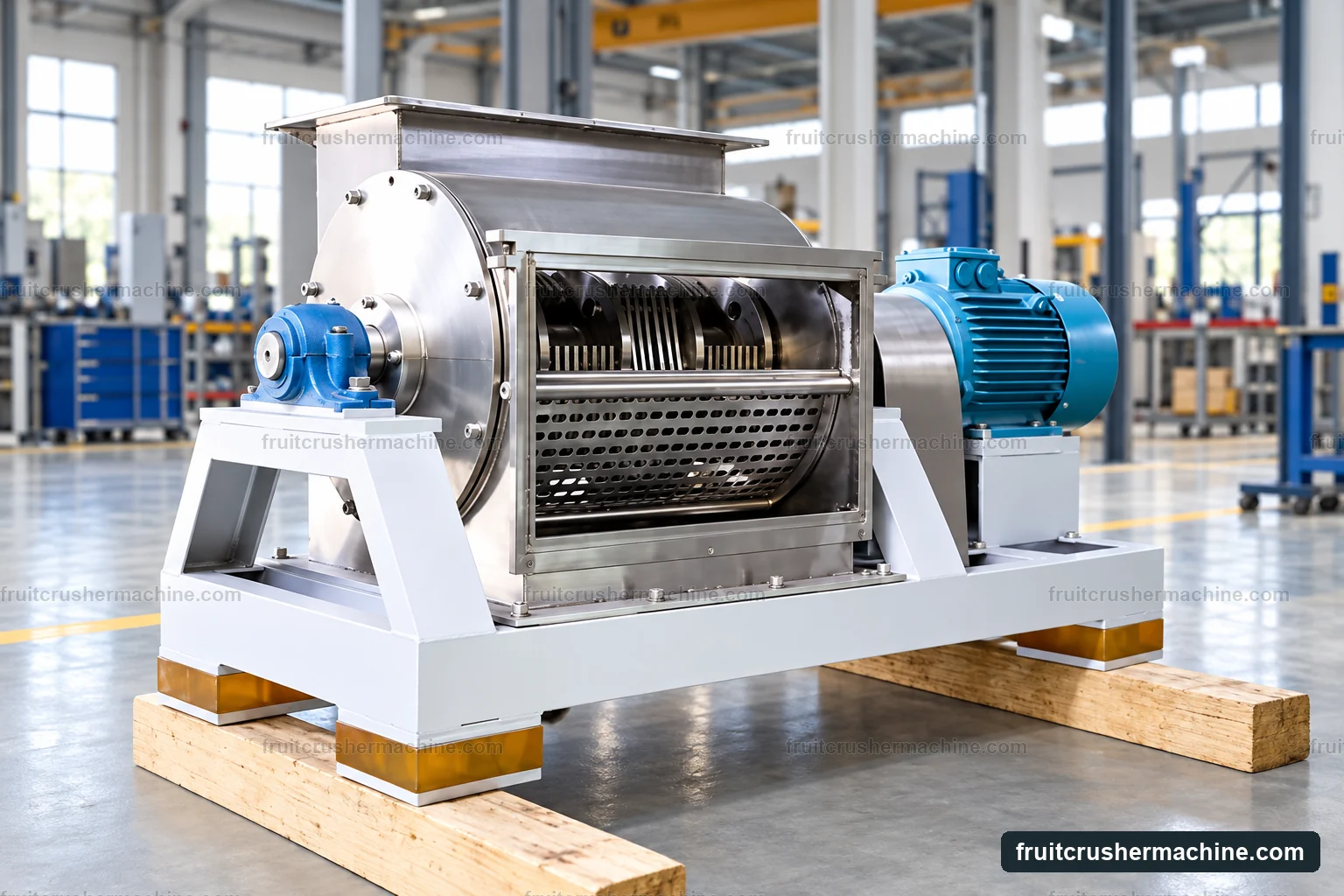
COMPONENT 03
Create the required material breakdown using the actual proposed working assembly. Tooling, clearance and any screen are evaluated together.
Discuss this componentInput, output and interfaces
| Input | Output | Interfaces |
|---|---|---|
| Fruit within the agreed preparation envelope. | A distribution of mash particles, fragments and liquid; not a single guaranteed particle size. | Shaft and attachment method, housing clearance, optional screening arrangement and service tooling. |
Specification questions
| Parameter | Condition to confirm |
|---|---|
| Assembly identity | Part drawing, material and operating principle for the offered model. |
| Settings | Record speed, clearances and any screen opening for every sample. |
| Output evidence | Sampling method, coarse fragments, fines and downstream performance. |
| Replacement parts | Part references, wear criteria, exchange procedure and balancing requirements where applicable. |
Cleaning and maintenance
Demonstrate removal and reassembly of replaceable product-contact parts using the manufacturer procedure. Avoid treating a narrow opening as automatically cleanable.
Selection boundary
Screen aperture is a hardware dimension; actual output particle distribution requires measurement. More motor power does not establish throughput.
STRUCTURE & OUTPUT
Working-principle options are not interchangeable.
Fruit crushers can use different size-reduction assemblies. This comparison is a purchasing checklist, not a claim that every PS model uses each design. The open family photograph shows a slotted working assembly and a perforated lower section; it does not by itself establish the rotor, hammer, knife or screen of the offered model.
| Assembly | How it works | What to confirm |
|---|---|---|
| Knife or chopper | Cuts feed with blades or shaped cutters; output depends on blade geometry, clearance and feed presentation. | Blade material and access, maximum piece, speed, wear, and whether the assembly is intended for the fruit. |
| Hammer or swing beater | Reduces feed by impact; suitability depends on the actual feed and chamber. | Rotor and hammer drawing, screen, wear parts, heat or airflow, and the permitted inclusions. |
| Roller or toothed roll | Uses compression or shear with a controlled gap; feed uniformity matters. | Roll profile, gap adjustment, hard-object protection and product-contact materials. |
| Screen or perforated section | Retains material in the chamber; aperture is a hardware dimension, not a measured output distribution. | Screen identity, thickness, support, removal access and the sampling method used to judge mash. |
Request the offered model's drawing and parts list. A family photograph or a motor rating cannot establish the working principle, permissible stones, output particle distribution or throughput.
Define the feed envelope → Measure the mash → Separate crushing from de-stoning →